Pearson Mtel Foundations of Reading in Massachusetts Accepted in North Carolina
Welcome to the North Carolina Foundations of Reading 090 Practice Test and Prep page. We'll be introducing y'all to the cadre subareas and concepts yous demand to know to laissez passer this exam. This is one of the free resources we provide so y'all can see the loftier-level concepts you volition discover on the North Carolina Foundations of Reading test and judge how much you know.
Quick Links to Assist Y'all Navigate This Folio
- N Carolina Foundations of Reading Quick Facts
- Subarea I: Foundations of Reading Evolution
- Subarea II: Development of Reading Comprehension
- Subarea Three: Reading Cess and Educational activity
- Subarea IV: Integration of Noesis and Agreement
This 090 exam is designed to test your content knowledge in order to ensure that you are prepared to teach reading to students. The exam volition test you on reading development, reading comprehension, and reading assessment and instruction. It will besides determine whether you are able to integrate knowledge when working with texts.
Format:
The Foundations of Reading test contains 100 multiple-choice questions and 2 open up-response (or essay) questions. You lot will have iv hours of testing time and 15 minutes to complete a tutorial.
Cost: $139
Scoring:
Scores on the test take into account all subareas. This is good news for you lot considering if you are weaker in i subarea, yous can brand it up by doing well in another subarea.
Exam scores range betwixt 100 and 300. In order to pass, you'll need to score at least a 229.
Study time:
The corporeality of time that y'all volition need to study depends entirely upon your existing content knowledge and your ability to retain data. We suggest using our practice test to decide which areas you need the most help on.
In one case you tin identify the content that you demand extra help with, focus on those areas. Also, keep in mind that information technology's better to spend an hour or two studying each day than to cram for the test. By using this strategy, you are more than likely to retain data.
It's a great thought to use the exercise test multiple times, equally well. As you lot review your progress, y'all'll be relieved to run into that your difficult work is paying off!
Remember, when information technology comes to studying for the Foundations of Reading exam, there'south no such thing equally knowing the content too well. Since it's better to be prophylactic than sorry, spend enough of time studying. And so, you'll be ready to test like a rockstar!
What test takers wish they'd known:
It is essential to make it on time. If yous are xv minutes late (or more than) for your exam, you will non be admitted. Plan alee and go far a few minutes early.
Make sure to bring your government-issued ID. If you lot forget to bring your ID, you will be unable to take the test.
Be certain not to bring any prohibited materials when y'all become to take the test. Prohibited materials include cell phones and even scratch paper. It's not a good experience to have your score voided over an error like that!
If you accept difficulty with a question, flag it, and movement on to one that yous tin can answer more easily. You tin can return to any question at any time.
It's better to guess than to leave a question blank! You will not be penalized for an wrong reply, so any guess is better than no response. Return to any difficult questions that you flagged before completing the test. Eliminate any plain incorrect choices, and guess from the residual.
Information technology'south not wise to try to save time past skimming over the instructions. If you read carefully, you'll avoid the risk of missing important data which could touch on your score.
During written assignments, brand sure that yous respond to all of the assignments and read back over what you lot've written. Many test-takers catch their own mistakes that fashion!
Relax. Information technology is just an exam. We're sure that we can get you to where you need to be.
Information obtained from the National Evaluation Serial website: www.nc.nesinc.com
Overview
Subarea I accounts for about 35% of the exam.
This subarea has iv objectives:
- Phonological and Phonemic Awareness
- Concepts of Print and the Alphabetic Principle
- Phonics
- Word Analysis
Phonological and Phonemic Awareness
This section tests your ability to piece of work with phonemes, which are the smallest unit of spoken words. In gild to pass this portion of the test, you'll demand to understand how phonemes are blended to make words, also as how words tin can be segmented into individual phonemes. You will be tested on your power to promote phonemic and phonological awareness in readers and to distinguish between different phonemes.
Permit's discuss some concepts that will more than than likely appear on the test.
Phonological Awareness
Phonological sensation is the ability to recognize and work with spoken language. Keep in mind that phonological awareness refers to what students hear, not what they read. Long before children learn to read, they learn the meaning of spoken words. This auditory skill is actually the very outset of learning to read!
There are a lot of activities that y'all can use to teach phonological awareness. Hither are a few examples:
- Teaching plant nursery rhymes
- Reading stories with rhyming words aloud to students
- Helping students count out the syllables in a word
- Request students to place alliterative phrases
- Request students what new word is fabricated when a new phoneme is put in front end of an existing discussion
Phonemic Awareness
Phonemic awareness is a sub-skill that falls under phonological awareness. Phonemic awareness refers to working specifically with phonemes. One example of promoting phonemic awareness is to provide students with a list of words and inquire which word does not belong.
For example, if yous ask students which word does not belong out of the words "true cat," "pen," and "cup," they should recognize that "pen" does not vest. Why? "Pen" does not vest, considering it does not begin with the aforementioned phoneme as the other two words.
Another fashion to accost phonemic sensation is to present students with a root, such as "-ell." Ask students what words can be formed past adding a new sound to the beginning of the root. For instance, adding the /t/ sound produces "tell." Adding the /w/ sound produces "well."
Blending
Phoneme blending is the skill of listening to private sounds and putting the sounds together to brand a word. Blending tin can be taught past request students to sound out words as they read. For example, a starting time reader will sound out "cat" with the sounds of the letters: /grand/ /a/ /t/. Readers should exist encouraged to sound out letters, and then put the sounds together to class and recognize a word.
Another mode to teach students how to blend is to place pictures of objects in front end of students. Very slowly sound out the names of the objects in the pictures (i.e. /ppppllllaaaannnntttt/). Then, ask students to approximate which word you are proverb. Because yous will be speaking so slowly, students volition have to recollect about the individual phonemes that brand up the word.
Concepts of Print and the Alphabetic Principle
This section tests your knowledge of teaching students to read impress words and to sympathize the relationship between print words and spoken words. In club to do well on this department of the exam, you lot must be able to identify ways to teach students to recognize letters and their corresponding sounds. You'll also demand to have an understanding of how readers larn to track print and which strategies assist them learn this skill.
Here are some concepts that you may see on the test.
Ecology Print
And then what'due south environmental print and does it differ from standard print? Ecology impress is the print of everyday life. It is the first type of print that students learn to "read." This is for a couple of dissimilar reasons. For starters, children see environmental print frequently and before they begin looking at worksheets or the pages of a book. Furthermore, ecology print has a built-in "cheat sail" of context clues.
The sign of a McDonald's eating house is an example of environmental impress. Other logos and familiar street signs (such as a stop sign) are besides examples of ecology print. The letters e'er appear in a familiar font, setting, and colour.
How can yous work with ecology print in your classroom? Here are a few example activities:
- Create a bingo card using logos, such as the logos for Barbie and Lego, instead of using numbers. As you call out each discussion, students can place a marker on the corresponding logo.
- Collect some empty cereal boxes. Ask students to read what they see – "Cheerios," "Frosted Flakes," etc.
- Collect some labels from items that are made by popular brands, such as Campbell'southward and Play-Doh. Ask students to sort the labels into categories.
- Create an ecology print discussion wall. Enquire students to bring in examples of ecology print (Starburst wrapper, Starbucks loving cup, etc.). Cut out the logos and place them under the corresponding letter on the discussion wall. Students can refer to the environmental word wall while they are reading and writing.
Alphabetic Principle
The alphabetic principle is the thought that in that location are reliable relationships betwixt print letters and spoken sounds. This principle is important for emerging readers who demand to be able to associate written words with spoken language. Making the connection between the letters on a page and the words that they speak allows children to read.
Single sounds/messages should exist taught separately from combinations, such every bit /sh/ and /ch/. Get-go with unmarried messages helps keep students from becoming confused. You lot should also be sure to aid students differentiate betwixt similar-sounding letters, such as "b" and "p."
It is also best to avert teaching students to read similar-looking letters at the same time, such as "m" and "n." This practise will make information technology easier for your students to differentiate between letters.
Tracking
The left-to-correct and top-to-lesser arrangement of text is essential to the English language language. Students should be familiar with this pattern and able to engage in directional tracking. Directional tracking is only what it sounds like – readers should be able to follow forth with a text in the right social club.
You're certainly familiar with the act of a young child using her finger to trace along the text every bit a story is read. This is an example of directional tracking. Equally readers become more skillful, they no longer need to rely on their fingers for directional tracking.
Directional tracking is an particularly important concept to work on with English language language learners. If students have been taught to read in another language, they may have been taught to rail text differently.
Phonics
This section tests your knowledge of common spelling patterns, sight words, blending sounds, and teaching students to interpret words in text form. It will also assess how well you lot are able to determine the literacy of individual students. During this department, you lot will also be asked questions nearly didactics fluency.
Allow's look at some concepts that are guaranteed to come up upwards on the test.
Automaticity
Automaticity is the ability to recognize words immediately and without effort. Keep in listen that automaticity is not the same as fluency, a concept that we'll take a wait at shortly. Fluency requires automaticity.
A reader who has achieved automaticity is able to automatically interpret a give-and-take. How practise readers develop this skill? Automaticity is developed the aforementioned fashion that virtually skills are developed – practice, practice, practice! After achieving automaticity, a reader's mind is free to call back creatively nigh the text and to make connections and meaning.
Decoding versus Encoding
Decoding and encoding are total opposites, yet they're only like two peas in a pod. Decoding refers to the process of reading – translating words into sounds and ideas. Encoding refers to building words with sounds.
Both skills are crucial for literacy; students who are proficient in English can both read and write. When you call back of decoding, just call back of breaking a code. Subsequently all, that's what reading is – breaking the code of messages and their patterns. When you recollect of encoding, yous know that information technology refers to the skill of writing.
Over time, readers will hone their skills of decoding and encoding. Repetitively reading the same text is a not bad fashion to have students sharpen their decoding skills. Directing students to write a word multiple times is a strategy to help them to build their encoding skills.
Fluency
In society to exist fluent in the English language language, students must first develop automaticity. One time they have progressed from sounding out words to automatically recognizing words are they able to get fluent readers.
Information technology's important to call up that fluency is non a particular milestone. Fluency varies over time and depends upon the text. Even a proficient reader may read unfamiliar words slowly.
Once students reach fluency, they move across labored decoding and are able to think more than securely almost the significant of the text. It is after achieving fluency that students really brainstorm to enjoy reading. At this point, reading is automatic and no longer a complicated chore.
There are multiple ways to boost and monitor fluency. Here are a few ideas:
- Try a "round-robin"-style reading in your classroom
- Partner students and have them mind to one another read
- Give students periods of fourth dimension in which to read silently, at their own paces
- Inquire students to record themselves while reading
- Direct students to read the same text more once
Common Word Patterns
Learning word patterns helps students to spell words, besides as decode unfamiliar words by sounding them out. As students begin to recognize discussion patterns, they begin to read more quickly and fluently. It is also easier for them to figure out the spelling and pronunciation of words based on the words that they already know.
The almost bones word patterns are CV (consonant-vowel), CVC (consonant-vowel-consonant), and CVVC (consonant-vowel-vowel-consonant). Permit's accept a look at some examples of each of these types of word patterns:
CV: This group contains the words
we, me, get and no. This is the easiest word design for students to observe.
CVC: This type of word pattern contains the words
cat, bed, log, gas and hog.
CVVC: This particular design contains the words
load, toad, road, heat, great, seat, fear, nigh and yr.
Word Analysis
This section tests your ability to recognize prefixes and suffixes and to determine their meanings. Yous will also demand to draw upon your knowledge of morphemes, homographs, and root words. It is also important that you are able to identify context clues so that yous can direct students to infer the meanings of unfamiliar words.
Here are some specific concepts that will more than than likely announced on the test.
Context Clues
All readers are unfamiliar with some words. When nosotros read a new word, we use the words around it to determine what it means. The same idea goes for unfamiliar phrases, such as idioms, that are strange to united states.
Accept a wait at the following text:
"That dog is horrible! We all know what a bad dog he is."
In this case, the synonym "bad" can help students decide the meaning of the discussion "horrible." Allow's look at how unlike context clues can also help students to determine the meaning of the same word:
"That dog is horrible! He chews the rug, barks, and gets the house muddy."
In this case, there is no synonym to aid the reader make up one's mind the meaning of "horrible." Notwithstanding, students can use the other data in the text to infer that the "horrible" domestic dog is bad.
Beginning readers may likewise need to determine the significant of unabridged phrases that are unfamiliar. Consider the following text:
"Henry was then tired. He couldn't look to hit the sack for the nighttime. Going to bed sounded like a great thought."
"Striking the sack" is an idiom, which obviously is not meant to be taken literally. A student who is unfamiliar with this phrase tin employ the clues in the text to determine that it actually means to go to bed.
Syllabication
Syllabication isn't a complicated concept. Information technology merely means the procedure by which words are broken into syllables. If a pupil can break a give-and-take into syllables, this tin can assist her to sound the word out. Once she sounds out the word, she tin can recognize and interpret information technology.
Remember that the number of vowel sounds in a discussion determines the number of syllables it contains. Here are some examples:
1 Syllable, 1 Vowel Sound: "got," "put," and "home." Notice that "dwelling house" has 2 vowels, but only one vowel sound. This distinction is of import.
2 Syllables, 2 Vowel Sounds: "discipline" and "relax." These ii words can be broken into two syllables –
sub/ject and re/lax.
iii Syllables, iii Vowel Sounds: "publishing" is an example of a three-syllable word that can be broken into
pub/lish/ing.
Homographs
Homographs are words that are spelled the same only have dissimilar meanings and may have different pronunciations. Here are a few examples:
- Lead – to become in front of; a type of metal
- Bow – a type of knot; to bend at the waist
- Bat – a blazon of animal; an instrument used to hitting a baseball
- Moving ridge – a gesture made with the hand; a groovy of h2o
As students read homographs, they must rely on context clues to determine the meanings of the words. After all, homographs are spelled merely alike!
And then, let'southward have a moment to dispel a fiddling fleck of confusion. How exercise homographs differ from homophones and homonyms?
Homophones are two words that are spelled differently, only sound alike. "Two" and "as well" is one example of a pair of homophones.
Another example is "pair" and "pear."
Now that we've covered words with the same audio and the same spelling, you might exist wondering what's left for homonyms. Retrieve of homonyms as a type of hybrid between homographs and homophones. Homonyms have the same spelling and the aforementioned pronunciation, but they differ in significant:
- Rose – a type of bloom; past tense of "rise"
- Fluke – fins on a whale'due south tail; an unusual or lucky upshot
- Bark – the sound a dog makes; the outer layer of a tree trunk
- Comport – an animal; to tolerate
Overview
Subarea Ii accounts for about 27% of the exam.
This subarea has three objectives:
- Vocabulary
- Comprehension and Imaginative/Literary Texts
- Comprehension and Informational/Expository Texts
Vocabulary
This department tests your cognition of vocabulary strategies, the oral and written comprehension of words, not-literal language, and foreign words and abbreviations commonly used in English. You should besides be able to identify the difference between standard written English and unremarkably spoken English. You will also be tested on your ability to use grammatically correct language and to identify bookish language from informal linguistic communication.
Permit's discuss some concepts that will more than than likely appear on the exam.
Give-and-take Maps
A word map, similar the one pictured below, is a visual vocabulary tool:
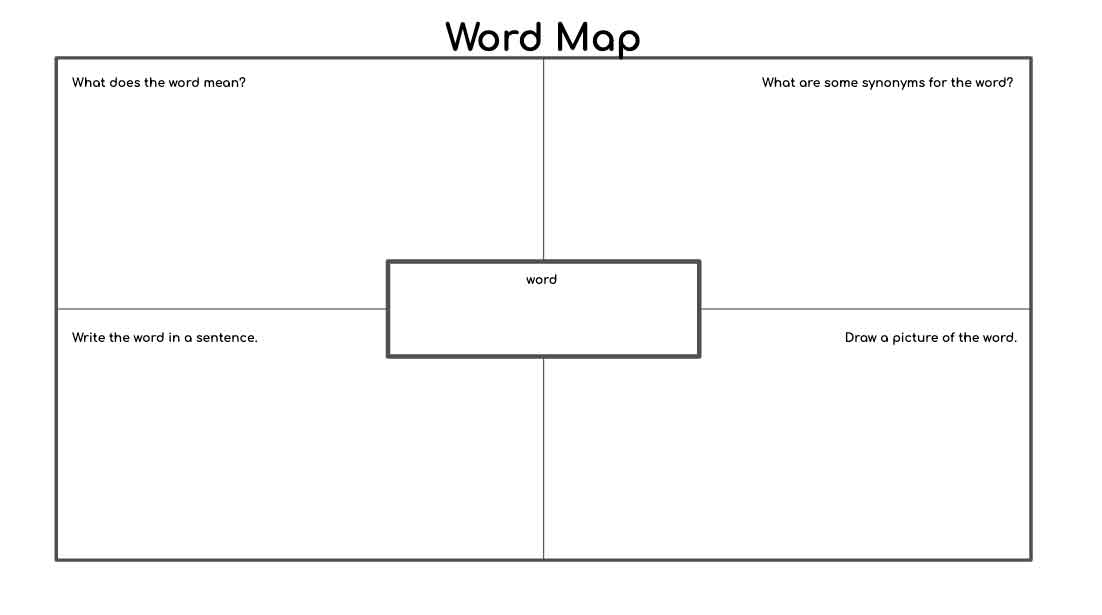
As students learn a new word, they can use word maps to relate the new word to terms with which they are already familiar. They can too use word maps to exercise using a discussion in context. Word maps likewise allow students to prove that they have learned the new vocabulary term.
Give-and-take maps can include a variety of prompts. Hither are a few examples of what might be included on a vocabulary word map:
- Define the term in your own words.
- Draw a picture to illustrate the discussion.
- Give a synonym for the word.
- Give an antonym for the word.
- Use the word meaningfully in a sentence.
- Re-create the dictionary definition of the word.
Academic Vocabulary
A crucial foundational reading skill is to exist able to cull words appropriately and to create and interpret both formal and informal text. Formal text in a classroom setting frequently includes academic vocabulary. This blazon of vocabulary is non unremarkably used in informal settings.
Academic vocabulary is usually specific to subject affair. Because academic vocabulary refers to words that are learned as students acquire new concepts, teaching academic vocabulary words is a smashing fashion to "teach beyond the curriculum." The introduction of academic vocabulary words will allow students to understand concepts outside of the English language language arts curriculum.
Examples of simple-level academic vocabulary words:
Subtraction
Dissolve
Thermometer
Economic system
Oral Linguistic communication Development
Of course, nosotros know that reading and writing are significant components of literacy. We need to likewise consider that the power to speak and listen in order to communicate finer is but as crucial. Later all, children's language skills don't begin on a slice of paper! Instead, these skills initially develop via oral communication.
At that place are v chief stages of language development:
Silent or Receptive
When learning a linguistic communication, individuals initially listen and gradually begin to understand the meaning of words and phrases.
Early on Production
During this phase, learners start to use new vocabulary terms in a meaningful manner while speaking.
Spoken communication Emergence
At this stage, learners have a greater comprehension of words and how to orally relay meaningful phrases, sentences, and questions.
They may yet brand errors, such as using the wrong tense or awkwardly phrasing an idea.
Intermediate Fluency
Learners at this stage speak with a much broader vocabulary and are able to use advisable grammar virtually of the time.
Advanced Fluency and Continued Evolution
During this stage, learners retain their fluency and recall the vocabulary terms that they caused during the previous stages. They continue to hone their oral advice skills.
Here are some tips on how teachers can encourage oral language evolution in the classroom:
- Pose questions aloud and permit students to reply. Ready rules for discussions, such as asking students to wait their turn to speak instead of speaking over one some other.
- Give students positive feedback for speaking clearly and correctly.
- Allow students to do using different tones when speaking.
- Ask students to comprise new vocabulary words into conversations.
- Remind students of the correct pronunciation of words with which they accept difficulty.
- Discuss the difference between formal and informal speech.
After giving oral instructions, bank check for agreement by asking students to paraphrase the directions.
Comprehension and Imaginative/Literary Texts
This section tests your noesis of teaching literature to students. In order to perform well in this department, you should know how to check for reading comprehension and how to instruct students to create summaries and to use textual evidence to attain conclusions. Other topics addressed in this department include the identification of fiction genres, figurative language, and point of view.
Types of Comprehension
Reading comprehension is the ability to meaningfully interpret a text. Readers must
exist able to decode words, brand connections between the text and prior noesis, and contemplate what they read. There are three levels of reading comprehension:
Literal Comprehension
Literal comprehension is the ability to understand the author'south explicit meaning. Readers should exist able to recognize and recall facts, to place primary ideas, to summarize a text, and to describe supporting details.
Example questions to cheque for literal comprehension:
What is the master idea of the story?
Tin you lot summarize this story?
How did this character respond to the event at the outset of the story?
What happened first in the story?
Which particular from the story is the least important?
Inferential Comprehension
Readers must exist able to think beyond what the writer explicitly states.
They must be able to take what the story literally says and to draw conclusions, or inferences, from the material. Inferential comprehension too means looking for clues to make up one's mind an writer'south betoken of view, determine the meaning of figurative linguistic communication, and draw conclusions about outcomes.
Example questions to bank check for inferential comprehension:
How would the story have ended if that grapheme behaved differently?
What value is most important to the author?
What lesson does this story teach?
Now that the story is over, what practise you lot think the characters would do side by side?
Evaluative or Critical Comprehension
Readers who have achieved this level of comprehension respond emotionally and intellectually to the text. They express opinions most the text and compare what they read to their own experiences. Readers at this level are also able to show how authors use textual prove to support ideas.
Example questions to check for evaluative/critical comprehension:
Have you lot ever had an feel like the one in this story?
Does this effect brand sense to y'all?
Do you recollect the story should have ended differently?
What communication would you give to the main character?
Which grapheme practice you relate to the virtually? Why?
Story Elements
The principal elements of a fiction story are the setting, characters, the trouble/conflict, and the solution/resolution. Students should be able to identify each of these elements and to explain how they impact one some other. In guild to explore this concept a footling more than, nosotros'll explore the fairytale Little Ruby Riding Hood:
Setting: When and where does the story occur?
In this instance, the story occurs in a couple of different locations: the woods and Grandmother'southward business firm. The "when" may vary depending on the version of the story yous're reading, simply for our purposes, we'll just say "long, long ago."
Characters: Who is in the story?
The characters in the story are Cherry-red Riding Hood, Grandmother, the Big Bad Wolf, and the Woodcutter.
Conflict: What is the main trouble in the story?
The Large Bad Wolf eats Grandmother.
Resolution: How is the problem solved?
In modern tellings of the story, the Woodcutter commonly comes and (possibly a little ridiculously) forces the wolf to spit out Grandmother. In the classic tale, which is more gruesome, the Woodcutter cuts open the Big Bad Wolf and rescues Grandmother.
Literary Allusions
An allusion is a reference to another work or to popular culture. The other piece of work maybe another book, or it may be a verse form, song, or fifty-fifty a movie. When an author makes an allusion, she assumes that the reader volition sympathize the reference.
Authors utilize allusions for a variety of reasons. Allusions let readers to connect with the text, and they brand the text seem more vivid and realistic. An innuendo tin also be made to add humor or to arm-twist an emotional response from the reader.
Hither are a couple of examples of literary allusions:
"Matt said he didn't break the vase, merely if he was Pinocchio, his olfactory organ would accept grown!"
This is an allusion to The Adventures of Pinocchio by Carlo Collodi. In this example, the writer assumes that the reader is familiar with the tale and tin figure out that Matt is lying, fifty-fifty though this fact is not explicitly stated. The allusion makes the statement more engaging for the reader.
Let'south look at another allusion:
"Jaime dyed his hair for the costume party. Unfortunately for him, the dye wouldn't wash out. To his dismay, he spent ii weeks looking like Ronald McDonald'south long-lost blood brother."
In this case, the writer makes an allusion to Ronald McDonald, a pop civilization, fast-nutrient mascot. This detail allusion helps the reader visualize Jaime's hair, and it besides adds some humor to the text!
Comprehension and Advisory/Expository Texts
This section tests your knowledge of informational text comprehension. As with reading literature, students should exist coached to comprehend the text at all 3 levels: literal comprehension, inferential comprehension, and evaluative/disquisitional comprehension. Readers skillful in this are able to differentiate fact from opinion, determine the author's viewpoint, and interact with various textual features and structures.
Fact versus Opinion
Some of the texts you'll encounter volition be strictly factual, while others will feature opinions. An opinionated viewpoint cannot be proven true or imitation. When because whether a passage is opinionated, inquire yourself what reasoning and testify a speaker uses to support ideas. Are they strictly factual, or are they biased?
Factual text:
"There are many varieties of peace lilies, a common houseplant with large green leaves. Peace lilies can grow upward to three feet alpine. Therefore, many people choose to keep peace lilies on their floors instead of on tabletops."
Opinionated text:
"There are many varieties of peace lilies, a common houseplant with large green leaves. Peace lilies can grow upwardly to three feet tall. Therefore, they are too large to really make adept houseplants."
Both texts include some factual data, but the second text uses the same bear witness equally the first text (establish peak) to support an opinion. Although the writer of the 2d example backs up her indicate of view, she is making a judgment call. Many people would disagree with her stance.
The author of the first text, still, states simply facts. How do you know? Research could be conducted to determine exactly how people employ peace lilies to decorate their homes.
Text Features
Text features, such as indexes and glossaries, are used to enhance the main body of a text. You are probably familiar with more text features than y'all might have thought. Readers should know how to employ text features to enhance their understanding of a text.
Here's a listing of a few common text features:
Appendix
This is a department at the end of the master text that gives boosted information. An appendix can help heighten the reader'due south understanding of the master text.
Captions
These are the words that correspond with and describe pictures and graphs. They are usually located underneath the visuals they refer to.
Diagram
A diagram is a visual created to show the parts of something or to explicate how something works. Information technology usually includes labels.
Footnote
A footnote provides data in addition to the primary text. It is found at the lesser of the page and is usually numbered.
Glossary
A glossary is plant at the back of a volume. It is a list of terms and appears very like to a lexicon.
Alphabetize
An alphabetize is also located at the back of the book. Indexes list important topics and tell the reader which pages to navigate to in order to acquire more well-nigh each topic.
Table of Contents
The tabular array of contents shows the chapters and/or other major sections of the book or certificate and provides page numbers. Information technology is located earlier the main text.
Text Structures
The construction of a text is the pattern or society in which information is presented. For case, think about how different reading a list is from reading a narrative. It is important that students can identify textual structures because the text structure affects the way in which ideas are presented to and understood by readers.
Allow's review some common text structures:
Chronological
This is the blazon of text structure virtually commonly establish in literature, but it appears in non-fiction materials, as well. A chronological text shows a sequence of events in the social club in which they occur.
Compare and Contrast
A compare/dissimilarity structured text explores the similarities and/or differences between two ideas. Students should know that comparison and contrasting are not the same. A comparison shows how two ideas are alike. Contrasting, on the other paw, shows how two ideas are different.
Cause and Consequence
A cause is a reason that an event occurs. It is important that a reader understands this concept because it profoundly impacts her understanding of the text. For example, if an article explains how air pollution causes global warming, the reader should understand the relationship between these two ideas. If the reader thinks that the ideas are unrelated or that global warming causes air pollution, she is not interpreting the text correctly.
And that'south some basic info about Subarea II: Development of Reading Comprehension.
Overview
Subarea III accounts for most 18% of the exam.
This subarea has 2 objectives:
- Assessment Methods
- Reading Educational activity
Assessment Methods
This section tests your noesis of the ability to appraise students' reading proficiency. It will include information about formal and breezy assessments and text leveling. Every bit a teacher, you volition need to instruct and back up both struggling and skilful readers and provide them with data-driven goals and strategies.
Here are some concepts that may announced on the test.
Norm-Referenced versus Criterion-Referenced Assessments
Norm-referenced tests are designed to compare readers to 1 another. Scores from norm-referenced tests are normally reported as percentiles which prove an private's rank in comparison to the performance of previous test-takers.
Criterion-referenced tests practice not compare students to one another. Instead, they take into account the number of correct answers submitted by an private and produce a score based on that information.
Some educators advocate for norm-referenced tests because they are adult by testing professionals at the national level. Other individuals argue that norm-referenced tests promote rote learning, but not complex and creative cognitive skills.
So, which blazon of assessment should you choose? The "best" blazon of assessment should be decided upon within the context of the situation.
Norm-referenced tests are non recommended to appraise the learning achievement of an unabridged group of individuals, simply just the relative performance of each pupil. Therefore, benchmark-referenced tests are preferred over norm-referenced tests when information technology comes to determining the performance of an entire class.
Running Record
Running records assess a student'due south reading progress through the evaluation of the private'due south oral reading and the identification of error patterns. A running record can assist yous runway a student'due south weaknesses. This type of graphic organizer can also assistance yous to track a student's growth over fourth dimension.
Running records are a two-step procedure which should be completed at intervals depending upon the power of the reader:
Early emergent readers (levels aa through C)–every 2 to 4 weeks
Emergent readers (levels D through J)–every 4 to half dozen weeks
Early fluent readers (levels K through P)–every six to 8 weeks
Fluent readers (levels Q through Z)–every viii to 10 weeks
For detailed information on taking and scoring a running tape, take a wait at this resources: www.readinga-z.com
This department tests your noesis of the ability to assess students' reading proficiency. It will include information about formal and informal assessments and text leveling. Equally a instructor, you lot will need to instruct and back up both struggling and proficient readers and provide them with data-driven goals and strategies.
Hither are some concepts that may announced on the test.
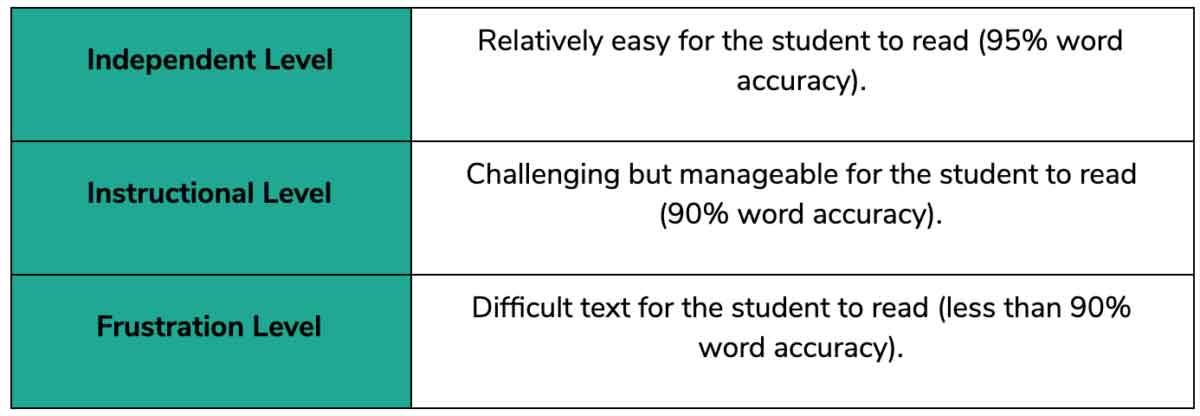
At the independent reading level, the reader has adequate background knowledge for the topic and can interpret the text very quickly, while making few errors. This is the highest reading level. As the name implies, this is the highest level a child tin can read independently.
The instructional level is the highest level at which the educatee has adequate groundwork noesis, yet cannot read independently.
This is the level at which you should aim to instruct your students. Most of the materials presented to students should be at this level.
The frustration level is the level at which the student does not have the acceptable background cognition and/or cannot read the text at greater than 90% word accurateness. Basically, this is the level at which a material is likewise difficult for a pupil. You'll want to avoid educational activity at this level because frustrated readers become discouraged and may requite upwards or lose interest.
At the independent reading level, the reader has adequate background knowledge for the topic and can interpret the text very quickly, while making few errors. This is the highest reading level. As the name implies, this is the highest level a kid tin read independently.
The instructional level is the highest level at which the student has adequate background knowledge, nonetheless cannot read independently.
This is the level at which you should aim to instruct your students. Virtually of the materials presented to students should be at this level.
The frustration level is the level at which the student does not have the adequate background knowledge and/or cannot read the text at greater than 90% word accuracy. Basically, this is the level at which a fabric is too hard for a educatee. Yous'll desire to avoid pedagogy at this level considering frustrated readers go discouraged and may give up or lose involvement.
Reading Instruction
This section tests your knowledge of planning, implementing, and differentiating reading educational activity. You will be asked questions about reading strategies, such equally group students. Yous'll also evidence your knowledge of text complexity and the promotion of reading for enjoyment and learning.
Flexible Grouping
Flexible grouping refers to the practice of placing students in various types of groups in order to maximize learners' performance and enrich their experiences. Students can exist grouped and re-grouped as specific goals are developed and different activities nowadays themselves. Flexible grouping can be used to support both struggling and skilful readers and to encourage good for you socialization skills.
Here are a few examples of forms of flexible grouping :
Whole-class didactics:
This arrangement is frequently used when new concepts are introduced. When a teacher leads the entire course, this ways that students are "on the same page" in terms of expectations and that they receive the same academic guidance. The drawback of this model is that it does not allow for much differentiation.
Small-group education:
This strategy refers to grouping students into small groups based on their common needs and addressing those needs. For example, you lot might choose to group some very proficient readers together in order to enrich their reading experiences and to challenge them.
Pairing students:
Sometimes, the best instructional strategy is to match students with partners. Stronger readers can model for those in need of help. This strategy also allows students to requite each other immediate feedback.
Collaborative groups:
Placing students into small groups encourages teamwork and peer support. Every bit with partnering students, strong readers can help those who are struggling. Students benefit from learning new skills from 1 another and sharing experiences and ideas.
Text Complication
Text complication refers to the difficulty of a text and it is normally either measured in quantitative or qualitative terms:
Quantitative:
Quantitative complication refers to readability measures. Different schools often promote dissimilar systems of readability measures. These measures usually assign a number or letter to a text in lodge to reverberate its complexity. The quantitative measure is typically measured by software systems. Quantitative measures address word frequency, text cohesion, and the length of words and sentences.
Qualitative:
The qualitative evaluation of text refers to the meaning, structure, clarity, and linguistic communication complication of a text. Unlike quantitative complexity, this measure typically involves more man interaction. This measure permeates the surface knowledge involved in interpreting the pregnant of words and sentences. Qualitative measurement involves making connections and "reading beyond" the text to analyze and compare outside ideas and experiences.
A drawback to qualitative measures of text complication is that they are more than subjective and difficult to assess. Quantitative measures of text comprehension are piece of cake to gauge with software systems, still they do not reflect deeper interpretations of texts. You lot may choose to utilise both quantitative and qualitative measures to assess both a straightforward agreement of materials, as well equally the power to depict artistic conclusions and formulate new ideas.
Differentiation
Group students tin can exist a strategy used to differentiate education for learners at different levels. Teachers can employ the assessment measures described earlier to make up one's mind student needs before deciding upon a plan to differentiate instruction.
In order to differentiate instruction, teachers tin can divide students into small groups. That manner, the instructor has time to piece of work closely with students who do not sympathize a concept or skill. The instructor can re-teach the concept or skill and provide additional practice.
Teachers may also work with other small groups in a like way to provide differentiation. For instance, students who are not being challenged adequately in a whole-group setting would benefit from small group teaching on more avant-garde concepts. English language language learners may benefit from working together with an ELL teacher in a small grouping or having an ELL instructor in the classroom as a guide during whole-class instruction.
Teachers can also differentiate past appealing to different learning styles, also as different abilities and comprehension levels. Hither are a few strategies to differentiate for students with varying learning styles:
- Interview students to find out their favorite types of classroom activities
- Utilise videos, infographics, and audiobooks
- Offer different types of hands-on activities that appeal to kids who dearest art, technology, socializing, etc.
- Requite both spoken and written directions
- Allow students to motion in a class past providing stations for rotation
- Provide a designated quiet space
- Allow students to create an array of products to demonstrate understanding
- Group students who have like learning styles
And that's some basic info about Subarea III: Reading Cess and Educational activity.
Overview
Subarea IV accounts for most 20% of the exam.
This subarea of the test contains two open-response items. You volition be asked to requite a written response of 150–300 words for each of the two assignments. Use your fourth dimension to begin, write, review, and edit your essay for each of the two items.
Each of the ii items will correspond to one of the other three sections of the test: Reading Evolution, Reading Comprehension, or Reading Cess and Instruction. For example, you may be asked to write near the relationship betwixt vocabulary development and reading comprehension. You may also be asked to create an essay on the topic of differentiation.
Each essay will be given a score of i – 4, with 4 being the highest score. Your essay volition be judged on the following criteria:
Purpose: the extent to which the response achieves the purpose of the consignment
Subject cognition: appropriateness and accuracy in the application of subject knowledge
Support: quality and relevance of supporting show
Rationale: soundness of argument and degree of understanding of the subject field area
Exist sure to review each essay to ensure that you have met the criteria. Write conspicuously and for an audition of educators. Use right and formal grammar, spelling, and punctuation. Make sure that yous fully address the principal signal of the assignment and that you lot provide sufficient reasoning and evidence to support your ideas. Thinking back to the material which y'all simply brushed up on while completing other sections of the exam can aid you to write detailed and logical essays that prove your knowledge of the subject area.
Source: https://www.240tutoring.com/nc-prep/north-carolina-foundations-of-reading-practice-test/
0 Response to "Pearson Mtel Foundations of Reading in Massachusetts Accepted in North Carolina"
Post a Comment